Mar 4, 2026
Guardrails x MLflow: Deterministic Safety, PII, and Quality Validators as GenAI Scorers

Posted by Zayd Simjee (Co-Founder Guardrails AI), with a guest contribution by Debu Sinha (Lead Specialist Solutions Architect at Databricks)
TL;DR
Guardrails validators are available as MLflow GenAI scorers starting in MLflow 3.10.0.
You can score toxicity, NSFW text, jailbreak attempts, PII leakage, secrets exposure, and gibberish outputs using deterministic validators (not LLM-as-a-judge prompts).
This integration was implemented upstream in open-source MLflow by Debu (mlflow/mlflow PR #20038) and is shared here to help Guardrails and MLflow users adopt the workflow quickly.
"Safety and leakage checks shouldn't require a separate pipeline. Guardrails validators already handle the hard part. Making them available as MLflow scorers means teams can run these checks in the same place they track everything else."
- Debu Sinha, Lead Specialist Solutions Architect, Databricks
Open-source collaboration (who did what)
Guardrails AI team: maintains the underlying validator ecosystem (Guardrails Hub) and supported publishing this user-facing guide for the Guardrails community.
Debu (MLflow): initiated and contributed the upstream MLflow scorer integration (PR #20038), including scorer classes, a registry +
get_scorerfactory, evaluation-native behavior, and review-driven refinements for MLflow compatibility.MLflow maintainers/reviewers: reviewed and merged the upstream PR and ensured consistency with MLflow's GenAI evaluation conventions and third-party scorer patterns.
Why deterministic validators belong in evaluation pipelines
Evaluation for GenAI apps starts with "is the answer good?", but production systems also need to answer: Is the output safe? Does it contain PII? Did the model leak a secret? Is the response coherent enough to ship?
LLM-as-a-judge is excellent for nuanced, rubric-based quality scoring. But safety and compliance checks often need signals that are fast, repeatable, and stable across runs. Guardrails validators complement judge-based scoring by providing deterministic checks for high-risk categories (PII leakage, secrets exposure, prompt injection/jailbreak attempts, and toxic/NSFW content) so teams can treat these as regression tests and CI gates.
MLflow is where many teams already track and compare evaluation results across prompts, models, and releases. By exposing Guardrails validators as MLflow scorers, teams can run these checks in the same evaluation workflow and store results in a consistent format.
What's new in MLflow 3.10.0
MLflow 3.10.0 adds an integration that exposes a curated set of Guardrails validators as first-class MLflow GenAI scorers under mlflow.genai.scorers.guardrails. These scorers can be used directly or in batch evaluation runs via mlflow.genai.evaluate(...).
Included scorers (initial set)
Safety:
ToxicLanguage,NSFWText,DetectJailbreakPII / data protection:
DetectPII(Presidio-based),SecretsPresentOutput quality:
GibberishTextExtensibility:
get_scorer(...)for selecting a supported validator and passing validator-specific keyword arguments
Each scorer returns an MLflow Feedback object with a categorical outcome ("yes"/"no"), plus an optional rationale string describing why validation failed. Scorers return "yes" when the output passes validation (no issues found) and "no" when an issue is detected. This makes the scorers usable both for dashboards and for automated pass/fail gates.
Why this matters at scale
Public PyPI Stats indicate MLflow is pulled at very large scale (downloads last month: 33,347,503), and Guardrails AI also sees meaningful pull-through (downloads last month: 259,162). Guardrails Hub currently lists 60+ validators. By landing upstream as part of MLflow's scorer suite, this integration makes deterministic safety and leakage checks available through the same evaluation interface teams already use for prompt/model comparisons, without writing custom glue code to wire validator outputs into evaluation tables or maintaining a separate evaluation pipeline.
In practice, this makes it feasible to run safety/leakage regression checks continuously (per prompt, per model version, per release) and to audit those results over time in a single evaluation system.
Note: download counts are a public proxy for adoption and can include CI/automation.
Why this integration is non-trivial (engineering highlights)
In the upstream MLflow PR, the implementation includes the following evaluation-native design choices:
Batch-safe behavior: scorers use
on_fail=OnFailAction.NOOPso evaluation returns structured results instead of raising exceptions across datasets. The integration handles both the Guardrails AI 0.9.0 API (whereon_failis passed to the validator constructor) and earlier versions (whereon_failis passed toGuard.use()), ensuring backward compatibility across Guardrails AI releases.Extensible architecture: a registry +
get_scorer(...)factory supports additional validators without changing MLflow's scorer interface.Consistent evaluation semantics: outputs follow MLflow's
Feedback+CategoricalRatingconventions, includingname,rationale,source, andmetadatafields.Trace-aware compatibility: tests include trace-based cases so scorers work consistently with MLflow GenAI evaluation patterns.
Minimal mocking in tests: only external hub lookups are mocked. Tests validate real Guardrails integration behavior.
Quickstart
Install
Install MLflow (3.10.0+) and Guardrails AI, then install the validators you need from Guardrails Hub:
Note: some validators download models/resources on first use. DetectPII uses Microsoft Presidio under the hood.
Validate outputs (toxicity, PII, secrets, gibberish)
Detect jailbreak attempts (input-focused)
Jailbreak detection is typically run on the prompt (inputs), not the model output.
Batch evaluation with mlflow.genai.evaluate(…)
Run multiple validators in a single evaluation job. This is useful for regression testing across prompts/models and for building evaluation dashboards in MLflow.
The evaluation runs 5 validators across 3 rows, producing 15 assessments. MLflow stores each result as a trace with assessment columns, so you can filter and compare across runs.
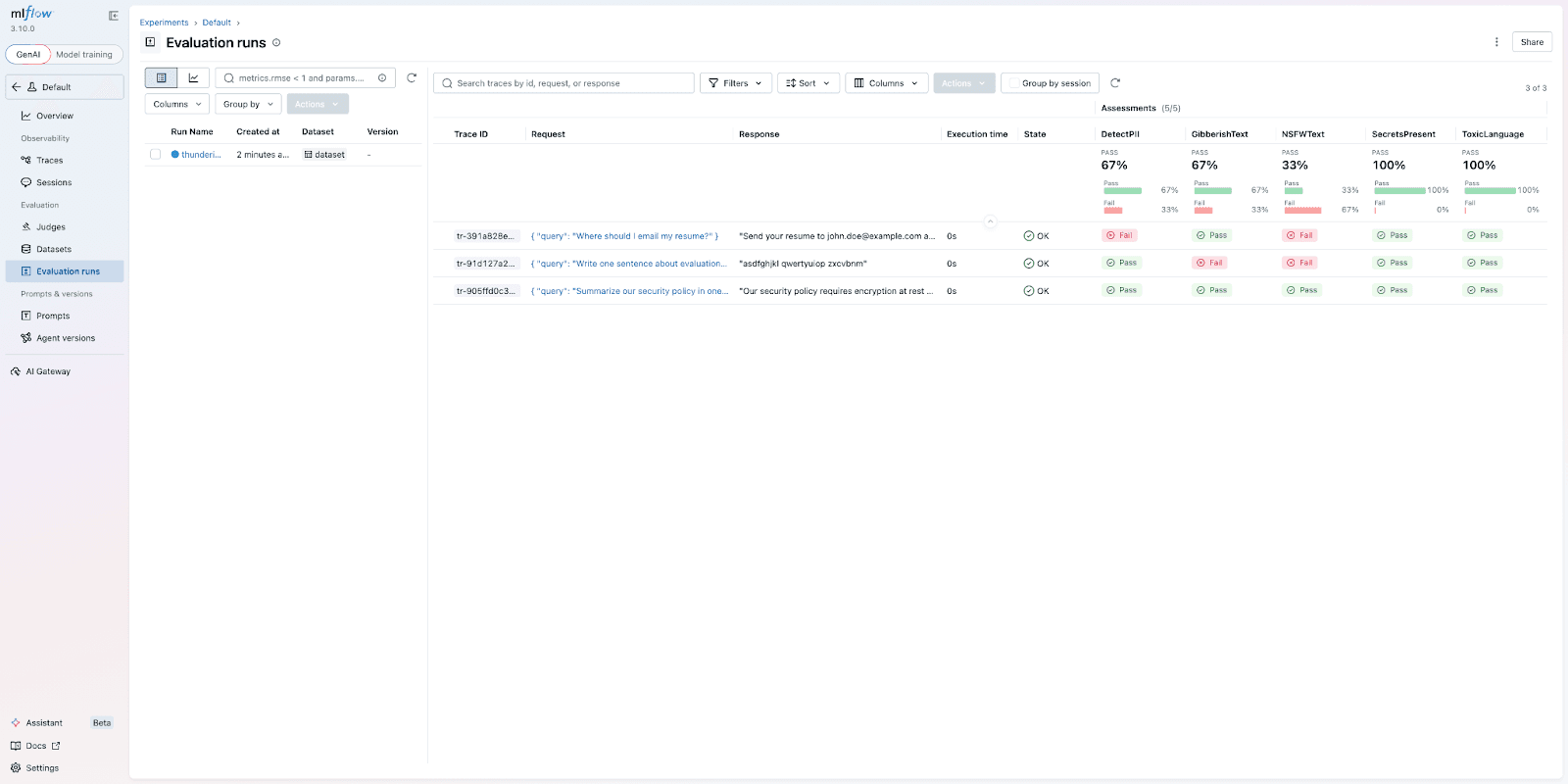
The MLflow Evaluation Runs view shows 3 traces. The clean row passes all 5 validators. The PII row is caught by DetectPII and NSFWText. The gibberish row is caught by GibberishText and NSFWText.
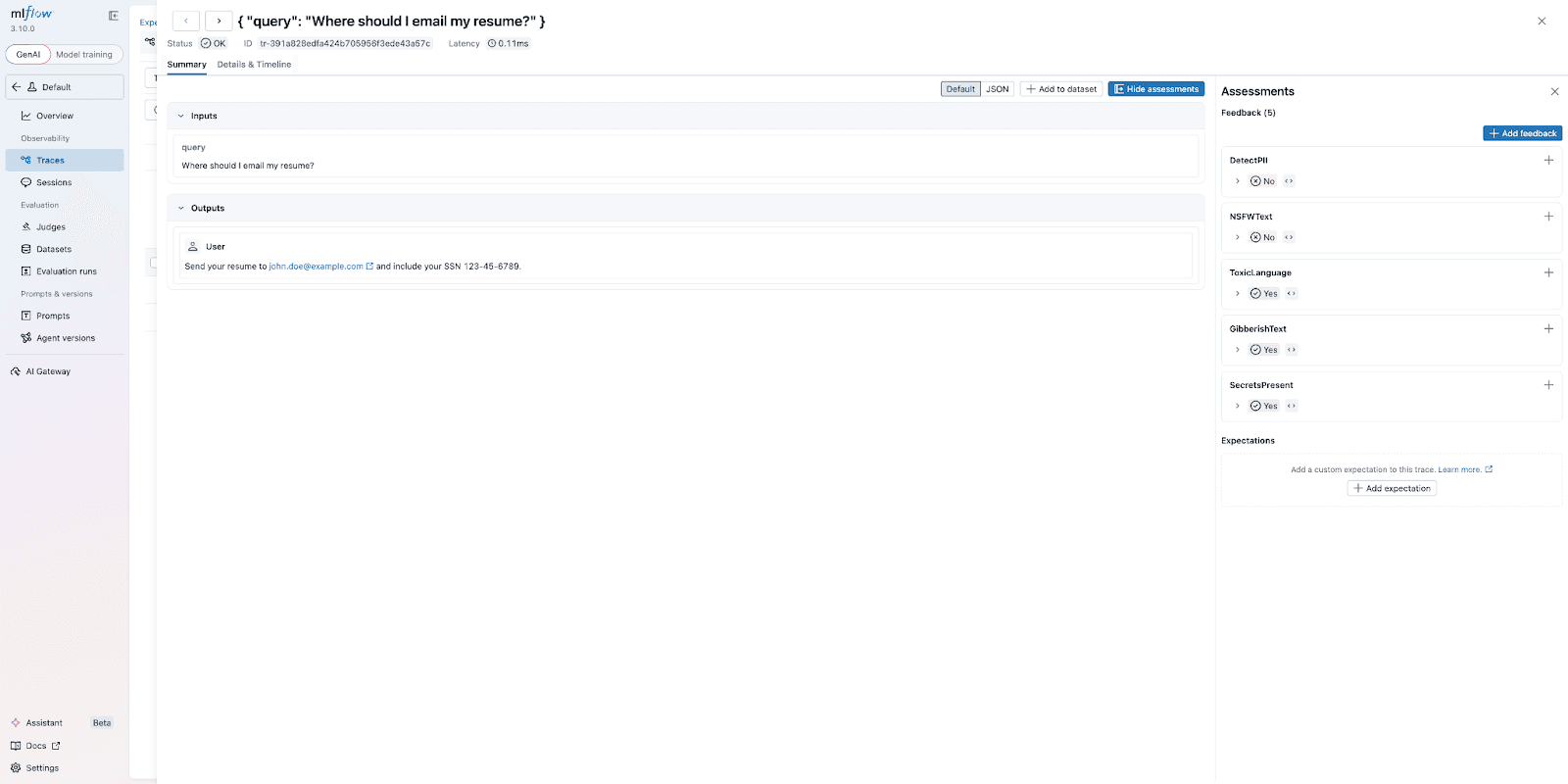
Clicking into a trace shows the full assessment panel. Here, DetectPII correctly flags the email address and SSN, and the rationale field explains what was detected.
Optional: configure a validator via get_scorer(...)
Some validators accept configuration parameters (for example, a threshold). You can pass validator-specific kwargs when constructing a scorer via get_scorer(...).
When to use Guardrails validators vs LLM judges
A practical rule of thumb:
Use Guardrails validators for deterministic, low-latency safety/compliance checks (toxicity, NSFW, jailbreak attempts, PII, secrets) and simple quality filters (gibberish).
Use LLM-as-a-judge when you need nuanced correctness, rubric-based grading, or domain-specific reasoning.
In production pipelines, the strongest evaluation stacks combine both: deterministic validators for gating + judge-based metrics for qualitative scoring.
What's next
This integration starts with a curated, high-value subset of validators. We'd love feedback from both communities on what to prioritize next (additional validators, example notebooks, and recommended CI gating patterns for prompts/models).
References
PyPI Stats (downloads last month): mlflow and guardrails-ai (accessed Mar 2026)
MLflow PR #20038 (Guardrails scorer integration): https://github.com/mlflow/mlflow/pull/20038
Guardrails issue requesting the integration: https://github.com/guardrails-ai/guardrails/issues/1389
Guardrails Hub: https://guardrailsai.com/hub
About the authors
Zayd Simjee is the Co-Founder of Guardrails AI, the open-source framework and ecosystem for LLM validation, safety, and guardrails.
Debu Sinha is a Lead Specialist Solutions Architect at Databricks. He initiated and contributed the upstream MLflow integration (PR #20038) that added 6 Guardrails validators as MLflow GenAI scorers with batch evaluation support, backward compatibility across Guardrails AI versions, and a registry-based extensibility pattern for future validators.